


Delivering Confidence and Care for Children Everywhere
When exporting or selling products in Saudi Arabia, compliance with local regulations is crucial. Two of the main regulatory tools that businesses encounter are the Saudi Quality Mark (SQM) and the SASO Certificate. While both are essential for market entry, they serve different purposes and follow different processes.
1. Saudi Quality Mark (SQM)
The Saudi Quality Mark (SQM) is a voluntary or mandatory Mark, depending on the product category, that indicates compliance with Saudi Standards, Metrology, and Quality Organization (SASO) requirements. It primarily focuses on:
- Ensuring product safety, performance, and quality.
- Demonstrating compliance with Saudi standards to consumers and regulators.
- Serving as a trust mark for both local and imported products.
Key features of SQM:
- May require product testing, factory inspection, and documentation review.
- Mark can be renewed periodically to ensure ongoing compliance.
- Often used for consumer goods, electronics, appliances, and other regulated products.
- Approved products can carry the SQM logo, which increases consumer confidence.
2. SASO Certificate
The SABER system is an online platform managed by SASO that facilitates the registration and issuance of a Certificates of Conformity for products imported into Saudi Arabia. Unlike the SQM, the SASO Certificate is:
- Mandatory for all regulated imported products before they can clear Saudi customs.
- Focused on regulatory compliance rather than market trust or brand visibility.
- Obtained online through the SABER portal, often requiring product testing and submission of supporting documents.
Key features of SASO Certificate via SABER:
- It is essential for customs clearance in Saudi Arabia.
- Covers a wide range of product categories, including electrical appliances, toys, cosmetics, building materials, and more.
- Facilitates tracking and verification of compliance by authorities.
- Streamlines the import process, reducing delays at the port.
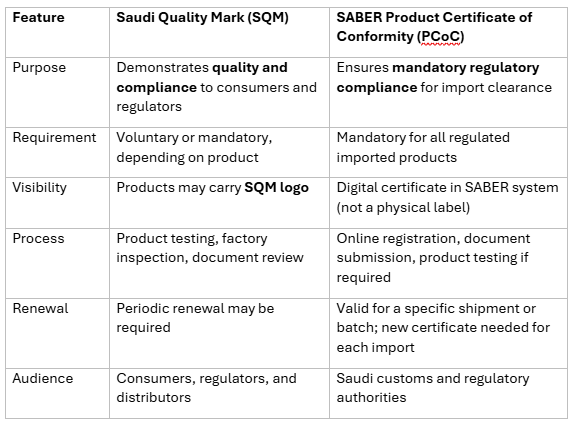
3. Key Differences Between SQM and PCoC
4. How Cotecna Can Help
Navigating the SQM and PCoC processes can be challenging for exporters fortunetly Cotecna can help with both. Cotecna offers expert guidance to:
- Determine whether your product requires SQM, SASO certificate, or both.
- Prepare all documentation and testing requirements efficiently.
- Ensure your certification is obtained quickly and seamlessly, reducing delays in entering the Saudi market.
By working with Cotecna, businesses can minimize compliance risks while ensuring that their products are fully prepared for both regulatory approval and market acceptance in Saudi Arabia.
Contact Cotecna middle East to get started or visit our dedicated Saudi Webpage for more.
About Cotecna
For over 50 years, we have been supporting agriculture, food and pharma, minerals and metals, and consumer products supply chains all over the world. We provide testing, inspection, and certification services to help our clients navigate evolving regulations, ensure product compliance, and support their sustainability journey.